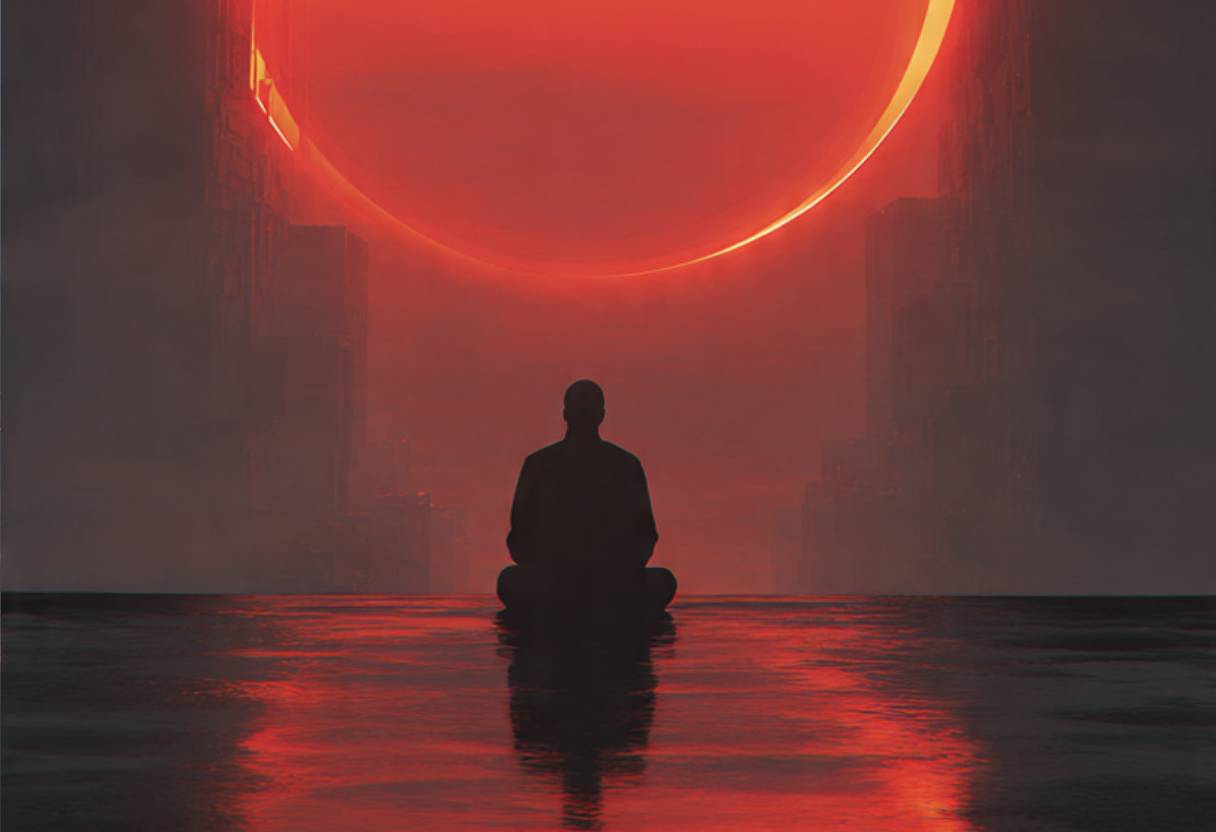
Book: The Power of Now – Eckhart Tolle
There was a time when my mind felt like a crowded room:
thoughts arguing, worrying, replaying, planning, judging.
I could be sitting still, but inside, everything was loud.
The Power of Now didn’t give me “new information” as much as it gave me a new position inside my own life. It showed me that I don’t have to live trapped inside my thoughts. I can live as the witness of them.
This post is about how this book helped dissolve layers of inner chaos and how I practice presence in my daily life.
The core shift: I am not my thoughts
One of the most important insights from Eckhart Tolle is simple, but radical when you actually live it:
“You are not your mind.”
Your thoughts, emotions, and stories appear in your awareness, but they are not you.
This opens a new possibility:
- Instead of being the anxiety, I can notice anxiety.
- Instead of being the judgment, I can notice judgment.
- Instead of being the mental noise, I can rest as the awareness behind it.
Once I saw this clearly, “inner chaos” stopped being my identity and became something I could observe.
The pain-body: how I kept feeding my own suffering
Tolle describes the pain-body as an energetic field of old emotional pain stored in us.
I started to notice this in myself:
- A small trigger would happen
- Suddenly, an oversized emotional reaction would come up
- The mind would jump in with old stories:
- “Here we go again…”
- “Nothing ever works out…”
- “I always end up here…”
That spiral used to feel automatic.
After reading this book, I began to see:
“This is my pain-body activating, not the full truth of the present moment.”
Instead of fueling it with more thinking, I practice something different now:
I allow the emotion to be felt in the body, without building a mental story around it.
This alone started to dissolve a lot of unnecessary suffering.
Living as the witness: the power of simple noticing
The central practice of The Power of Now is presence:
bringing attention out of the mind and into the Now.
In my daily life, this looks like:
- Feeling the sensation of my breath when I start to overthink
- Noticing the contact of my feet on the floor
- Listening fully when someone speaks, instead of preparing my reply
- Observing thoughts like clouds passing through the sky of awareness
The more I practice this, the more I notice a gap:
- There is a thought
- There is an emotion
- And there is also a silent awareness that is untouched by them
That silent awareness is where the chaos dissolves.
How I practice presence in my day
Presence for me is not just meditation; it’s a style of living.
Here is how I try to embody the book’s ideas in a practical way.
1. Micro-pauses: reclaiming the Now
Several times a day, I use simple triggers:
- When I open a door
- When I sit down
- When I’m about to start a new task
I take 1–2 conscious breaths and ask:
“Am I in my head, or am I here?”
This shift pulls me out of autopilot and back into the moment I’m actually living.
2. Feeling, not overthinking
When discomfort arises (anxiety, irritation, fear), my old pattern was:
Think more. Analyze more. Fix it in the head.
Now I do this instead:
- Drop attention from the head into the body
- Notice: “Where do I feel this?” (chest, stomach, throat)
- Stay with the raw sensation without calling it “good” or “bad”
Very often, the emotion peaks and then softens on its own when I don’t feed it with mental commentary.
3. Watching the thinker
This is straight from the book and has become one of my key practices:
Whenever the mind starts running, I simply notice:
- “Ah, the mind is creating a story.”
- “Here is the familiar loop of fear.”
- “Here is the urge to predict the future or replay the past.”
In that moment of noticing, I’m no longer fully inside the thought.
I am the one watching it.
This subtle difference is where the chaos loses its power.
How I take notes from The Power of Now
This is not a book I underline once and forget.
I treat it more like an anchor I return to.
My note-taking pattern is simple:
1. Phrases that pierce
I don’t copy whole paragraphs.
I capture only the lines that cut through my usual thinking, for example:
- “Realize deeply that the present moment is all you ever have.”
- “All problems are illusions of the mind.”
- “You are the sky. The thoughts are just weather.” (my paraphrase)
These become reminders that I revisit often.
2. Personal echoes
Below each quote or idea, I write:
- “Where in my life am I still lost in time (past/future)?”
- “What is one situation where I can choose presence instead of mental narrative?”
This turns the concept into a direct mirror.
3. Practical signals
I also note down specific signals that tell me I’ve left the Now:
- Tightness in the chest
- Fast, shallow breathing
- Repeating worries with no new insight
- Rehearsing imaginary arguments
Next to each signal, I write a small practice, for example:
- “When I notice chest tightness: pause, feel the sensation directly, one slow breath.”
Over time, my notes become a personal “Presence Playbook.”
How this changed my personal growth
Since working with The Power of Now, I’ve noticed some deep shifts:
- Less mental noise: The thoughts are still there, but they don’t drag me as far or as deep as before. I catch them earlier.
- More inner space: Even in challenging moments, there is a quiet place inside that is not in panic.
- More genuine responses: I react less on autopilot and respond more from clarity.
- A new relationship with time: I still plan, but I’m less obsessed with controlling outcomes. The focus is on how I am being right now.
Growth, for me, is no longer just about goals and achievements.
It’s about how present I am with the life that is already here.
Why this belongs on my Growth page
This page exists because presence is the foundation for everything else I’m building:
habits, work, wealth, energy, relationships, creativity.
Without presence, I live as a bundle of reactions.
With presence, I live as the witness who can choose.
If you’re reading this on my Growth site, consider this an invitation:
Before you fix your life, try meeting it.
Before you solve your mind, try watching it.Sometimes the chaos doesn’t need to be defeated.
It just needs to be seen from somewhere deeper than thought.