

Never Split the Difference is useful because it treats listening as active preparation rather than a polite pause before we make our own case.
Our strongest takeaway is not “learn a trick that makes people comply.” It is more disciplined than that: understand what the other person is actually saying, test what may be underneath it, and improve the information available before deciding what to do next.
What WE learned
- A position is not the whole story. A demand, refusal, price, deadline, or objection may be protecting a concern we have not yet understood.
- Tactical empathy is not mind-reading. We can form hypotheses about needs, fears, constraints, or priorities, but those hypotheses still need verification.
- Mirrors and labels can invite clarification. Reflecting a few words or naming a possible emotion can create room for correction and additional information.
- Calibrated questions keep the conversation open. Good “what” and “how” questions can reveal constraints without forcing an immediate argument.
- Understanding is not agreement. We can understand what matters to someone and still keep our own boundary, price, term, or decision.
1 · Listen for what may be underneath the position
When someone says “That deadline is impossible,” “That price is too high,” or “I will not agree to that,” it is tempting to respond directly to the surface statement.
Sometimes that is necessary. But a better first question can be: What might this position be protecting?
Time, risk, workload, reputation, fairness, uncertainty, autonomy, or something else may be involved. The important word is might. We do not know until we ask.
2 · Use empathy as a hypothesis, not a diagnosis
Labels such as “It sounds like the timing is the bigger concern” are useful when they leave room to be corrected.
That is different from announcing what another person “really feels.” The purpose is not to prove our intuition. It is to create a low-friction way for the other person to say, “Yes,” “Not exactly,” or “No, the real issue is…”
That correction is valuable information.
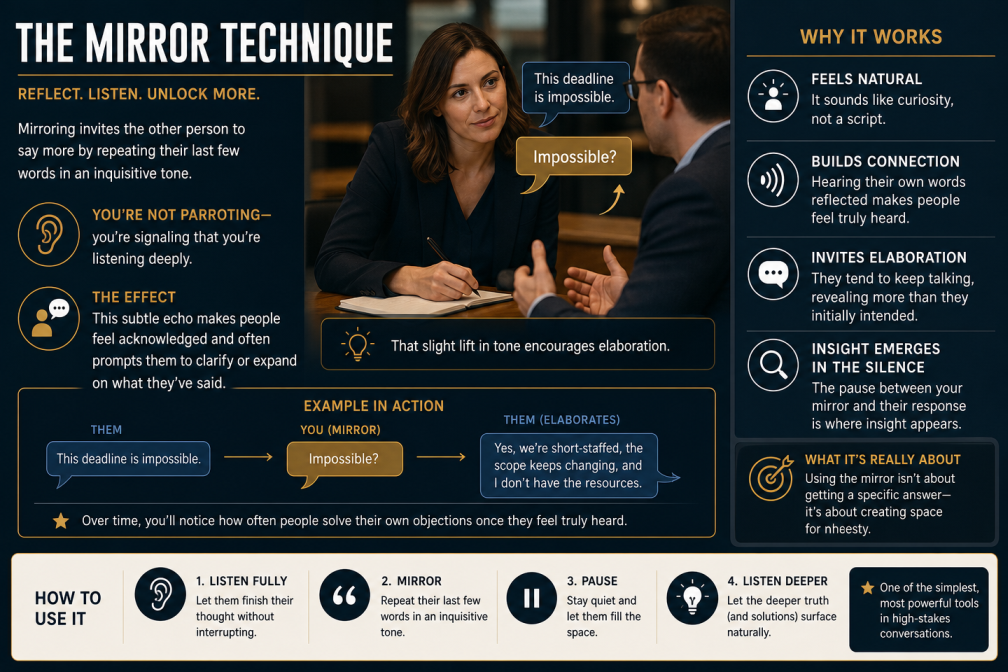
3 · Let mirrors do less work than our assumptions
A mirror repeats a short part of what someone said, usually as a question.
If someone says, “This timeline puts my team at risk,” a simple “At risk?” can invite them to explain further.
The value is not that the mirror gives us control. The value is that it helps us avoid filling the silence with our own interpretation too quickly.
4 · Ask questions that reveal constraints
Calibrated questions such as “What makes this difficult?” or “How would that work on your side?” can shift the exchange from competing assertions toward useful information.
The best questions are not designed to trap someone into the answer we want. They are designed to expose the real problem well enough that both sides can make a better decision.
5 · Keep autonomy and boundaries visible
One of the most useful ideas in the book is that “no” can carry information. A person who is allowed to disagree may be more willing to explain what matters.
But empathy does not require surrendering our own position. We can understand why a term matters to someone without accepting it. We can acknowledge a constraint and still propose an alternative.
Listening improves negotiation when it increases clarity—not when it becomes another way to conceal pressure.
What this changes
Before a difficult negotiation, we can ask:
- What did the other person actually say?
- What am I assuming it means?
- What concern or constraint might be involved?
- What question would help me verify that?
- What do I need to understand before making my case?
- Which boundary or non-negotiable must remain clear?
This changes the order of operations: understand before persuading.
From WE learned to I experienced
The paired Journal explores what changed when I stopped treating a strong position as the whole story and became more willing to ask before assuming.